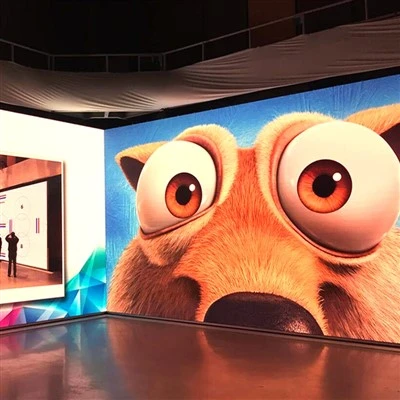

A stage LED display is an electronic display device that utilizes light-emitting diodes (LEDs) as its primary display elements; it is mainly used for stage backdrops, live video playback, visual effects, and information dissemination. It forms a complete image by arranging a vast number of LED beads into pixels and using a control system to adjust the brightness and color of each pixel. Typically, these displays use red, green, and blue LED beads as basic display units; by controlling the brightness ratios of these three colors, a rich spectrum of colors can be produced. Factors such as resolution, pixel pitch, and the number of LED beads directly affect image clarity; a smaller pixel pitch generally yields a more detailed image when viewed from the same distance.
In terms of system architecture, a stage LED display consists of several key components: LED display modules, drive circuitry, a control system, a power supply system, and the cabinet structure. LED display modules serve as the basic display units, converting electrical signals into visible light signals. The drive circuitry illuminates the LED beads and adjusts their brightness based on control data. The control system receives signals from sources such as computers, cameras, or video players, processes the image data, and transmits it to the display. The power supply system provides stable voltage and current to the various modules, while the cabinet structure secures and protects the components while facilitating installation and disassembly. These components work in concert to enable the display to show images and videos effectively.
In stage applications, video signal processing is a crucial aspect of LED display technology. Since there may be discrepancies between the input video signal and the display's native resolution, video processing equipment is often used to scale, crop, switch, and convert the signal format to meet the display's operational requirements. For large-scale stages, multiple sending and receiving devices may be employed to distribute a single image across various LED cabinets, ensuring synchronized display across multiple screens. Video processing systems also enable the combination of images across different display areas-such as main screens, side screens, and floor screens-thereby enriching the stage's visual effects.
Refresh rate and grayscale depth are also significant technical specifications for stage LED displays. Refresh rate refers to the number of times a screen updates its image within a given period; a higher refresh rate generally results in more stable motion and reduces issues such as flickering and scanning lines when the stage is being filmed. Grayscale represents the various brightness levels of LED beads, ranging from dark to bright; a wider range of grayscale levels typically yields more natural transitions between light and dark areas-a difference particularly noticeable when displaying stage background videos, gradients, and dark scenes. Additionally, parameters such as brightness, contrast, color temperature, and color uniformity affect the final visual output; therefore, during installation and calibration, these settings must be optimized based on stage lighting, viewing distance, and filming requirements.
To meet the needs of diverse stage environments, LED displays have evolved to feature various structural designs and installation methods. For instance, indoor stages often demand high image detail and color fidelity, leading to the selection of products with finer pixel pitches, whereas outdoor stages prioritize screen brightness, dust and water resistance, and structural stability. Some stages also utilize specialized configurations-such as curved screens, irregularly shaped displays, and LED floor screens-to complement the stage design and performance choreography. Modular design allows LED displays to be assembled according to venue size while facilitating transport, installation, maintenance, and component replacement. With continuous advancements in control and display technologies, stage LED displays have evolved from simple background screens into comprehensive visual systems that integrate video playback, real-time imagery, stage effects, and multi-screen synchronization.