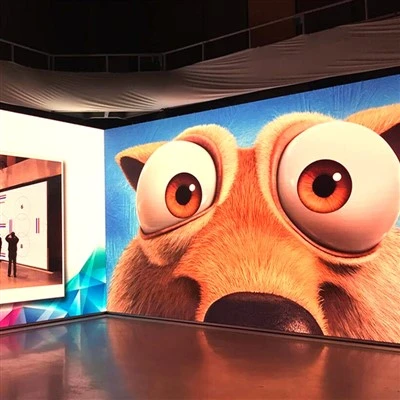


The most notable features of stage LED displays are their high brightness and image clarity, as well as their ability to adapt to complex stage lighting environments. Stage performances often utilize various lighting fixtures-such as follow-spots, wash lights, and moving head lights-resulting in significant fluctuations in ambient light; if a display lacks sufficient brightness, image quality can easily be compromised. By utilizing a vast array of light-emitting diodes (LEDs) as display units, these screens allow for brightness adjustments based on the environment, ensuring excellent visibility under diverse lighting conditions. Furthermore, LED displays offer superior color reproduction capabilities; by combining red, green, and blue primary colors in varying intensities, they generate a rich color palette that renders videos, images, and stage backdrops more vivid and natural. When playing high-definition stage content, the screens faithfully reproduce figures, landscapes, and dynamic visuals, thereby enhancing the visual experience for the audience.
Stage LED displays are also characterized by their large surface area and flexible modularity. Unlike traditional stage backdrops, which are often constrained by fixed dimensions and structures, LED displays are assembled from multiple cabinets and modules, allowing the screen size to be tailored to the specific stage space. Large-scale LED screens can serve as the primary backdrop for major concerts, galas, and commercial events, while venues such as theaters and conference halls can select sizes suited to their specific requirements. Moreover, these displays are not limited to standard flat configurations; through various installation methods, they can be shaped into arcs, curves, or other unique forms, allowing for seamless integration with the stage architecture. Multiple screens can also be combined-such as a coordinated setup of main screens, side screens, and floor screens-enabling the audience to view the stage visuals from various angles and expanding the overall visual scope.
In terms of operation and control, stage LED displays offer the advantages of easy content updates and robust real-time control. These displays can interface with video processors, computers, cameras, and other control equipment, allowing content to be switched instantly in accordance with the performance schedule. For instance, a concert might feature live footage of the performer; a gala could switch background videos to match specific acts; and conferences or events might display text, images, and presentation materials. Staff can manage content switching, brightness adjustments, and image scaling simply by using the control system, eliminating the need for the frequent physical backdrop changes required by traditional stage setups. For live broadcasts or events requiring real-time filming, high-refresh-rate LED displays minimize issues such as flickering and scanning lines often captured by cameras, resulting in more stable on-screen visuals.
Stage LED displays also offer rapid response times, meeting the demands of video playback and dynamic visual effects. During performances, background visuals often need to shift in sync with the rhythm of the music, the movements of the performers, and the content of the show; slow response times in display equipment could lead to motion blur or choppy transitions. By using drive circuitry to rapidly control individual LEDs, these displays enable seamless video playback and fluid dynamic visuals. When paired with video processing equipment, they can also facilitate functions such as scene transitions, special effects, and multi-screen synchronization. Consequently, LED displays play a pivotal role in visual presentation for concerts, stage plays, television programs, large-scale galas, and various commercial events.
Furthermore, stage LED displays are highly adaptable to different environments and offer significant reusability. Since stage equipment frequently requires assembly, disassembly, and transport, these displays typically feature a modular, cabinet-based design that simplifies setup and breakdown. They can be reconfigured to fit different stage dimensions for events at various venues, thereby reducing the costs associated with manufacturing new equipment. Certain LED displays designed for outdoor performances also feature robust dust and water resistance, allowing them to withstand exposure to rain, dust, and temperature fluctuations. However, actual deployment still requires careful selection based on the screen's ingress protection (IP) rating, the installation environment, and on-site conditions. Overall, combining high brightness, high resolution, rich color reproduction, flexible configuration, ease of control, and impressive dynamic effects, stage LED displays have become a staple in modern stage visual design.