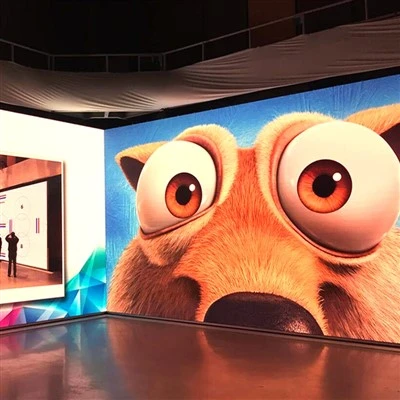

Indoor LED displays can be categorized based on pixel pitch into fine-pitch LED displays and standard-pitch LED displays. Fine-pitch LED displays feature a tighter pixel arrangement, typically offering higher resolution and superior image detail; suitable for close-range viewing, they are frequently used in conference rooms, command centers, exhibition halls, and broadcast studios. Standard-pitch LED displays have a relatively larger pixel pitch and are more cost-effective, making them suitable for indoor settings requiring larger display areas and longer viewing distances. The choice depends on factors such as screen size, viewing distance, and content; a smaller pixel pitch is not necessarily the best fit for every situation.
Indoor LED displays can also be classified into fixed, rental, flexible, and floor-tile LED displays. Fixed displays are typically installed in permanent locations like conference rooms, shopping malls, and exhibition halls; they feature stable cabinet structures designed for long-term use. Rental LED displays utilize a modular cabinet design for easy installation and dismantling, making them ideal for stage performances, commercial events, and large-scale conferences. Flexible LED displays offer excellent bendability, allowing them to be shaped into arcs, cylinders, or other unique forms to meet specific design requirements for stages and spatial aesthetics. Floor-tile LED displays are designed to bear weight and can be installed on stage floors, creating unique visual effects by displaying dynamic imagery.
Classifications also include flat, curved, irregularly shaped, and transparent LED displays. Flat screens feature a common structure that is relatively simple to install and maintain, offering a wide range of applications. Curved screens expand the viewing angle by adjusting the screen's curvature and enhance the sense of spatial depth on stage. Irregularly shaped screens can be customized to specific stage designs-such as circles, waves, or other non-standard forms-to create distinctive visual impacts. Transparent LED displays utilize specialized light strips and structural designs to offer transparency while maintaining display functionality; they are suitable for installation on glass curtain walls, in shop windows, and in indoor spaces where natural light preservation is required. Each type of LED display possesses unique characteristics regarding structure, visual performance, and application scenarios, necessitating selection based on the specific needs of the project.